Sharp cuts to non-essential spending, while safeguarding basic services
Budget reduced by 5.8% compared to 2025
Fiscal Deficit could reach around 70% should the Israeli occupation continue withholding Palestinian clearance revenues
Allocations for emergency expenditures and rapid response have been increased to NIS 516 million to address urgent contingencies
Measures will be implemented to strengthen domestic revenues without adversely affecting low-income groups
Government support for water, electricity, fuel, refugee camps, and health insurance amounts to NIS 1.3 billion, while social protection allocations for 2026 are estimated at approximately NIS 1.2 billion across various official institutions
Additional measures will be taken to reduce the wage bill in 2026, building on last year’s reduction of approximately NIS 120 million and the adoption of a zero-hiring policy
Financial settlements with local authorities and electricity and water companies will be completed in 2026, following progress in reducing these obligations by more than half over the past year
Priority will be given to completing only essential development projects, alongside efforts to mobilize external support expected to reach a total of NIS 880 million
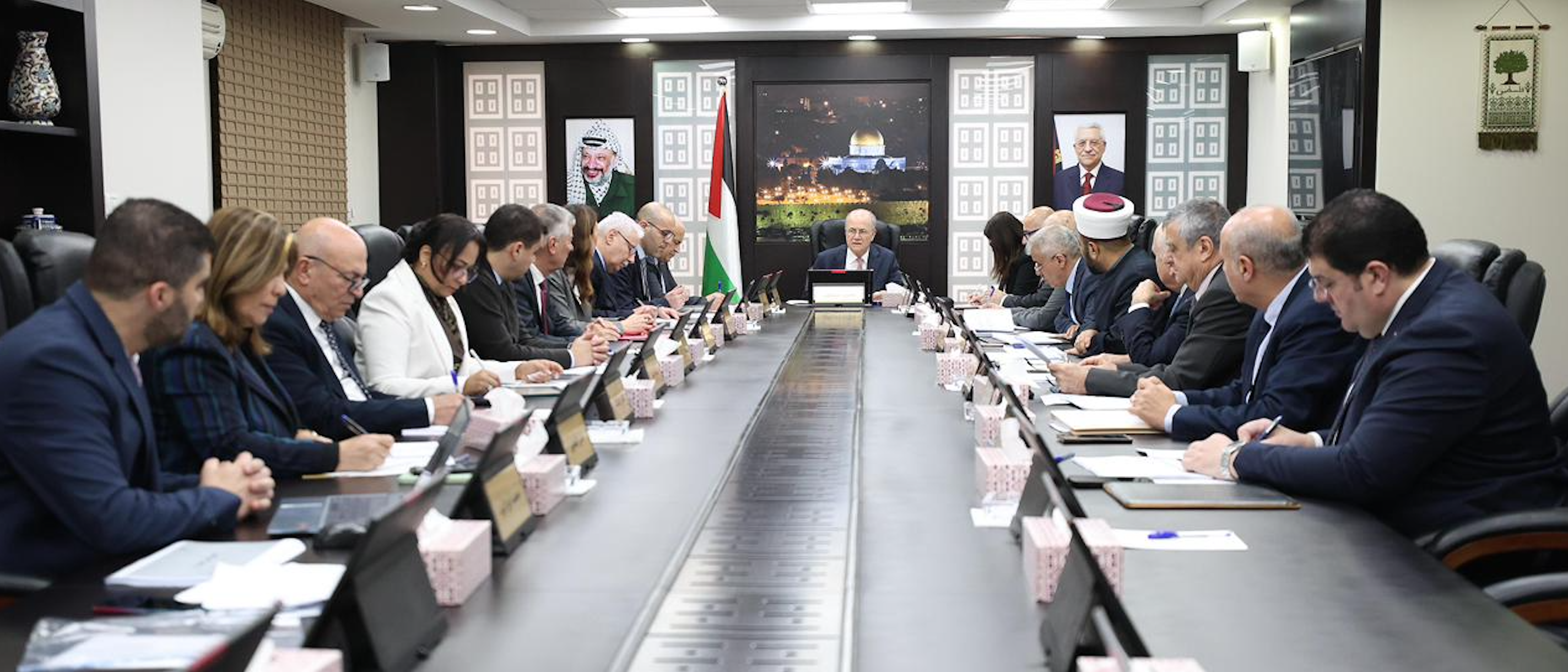
RAMALLAH, March 17, 2026 | Government Communication Center — The Palestinian Cabinet approved, during its weekly session on Tuesday, the draft 2026 emergency budget, which will be referred to President Mahmoud Abbas for ratification.
The emergency budget responds to the complex political, economic, and social realities, particularly in light of the likely continuation of the Israeli occupation government’s withholding of Palestinian clearance revenues. Accordingly, available cash flows will be directed toward essential services—primarily health, education, security, and social protection—while continuing to disburse a percentage of public sector salaries in line with available resources.
The draft budget also accounts for the potential continuation of the financial blockade and Israeli measures, prompting the Government to adopt a strict austerity approach that began in 2025 and will be further reinforced in 2026 to control spending and ensure the continuity of essential services.
According to the draft, total revenues are projected at approximately NIS 15.7 billion, including clearance revenues if released, while total expenditures are expected to reach around NIS 17.6 billion—representing a 5.8% decrease compared to the 2025 budget. Should the Israeli occupation continue withholding clearance revenues, the deficit is expected to rise to approximately 70% of the budget.
In line with the preparation of a budget responsive to emergency developments, allocations for emergency and rapid response expenditures have been significantly increased from around NIS 40 million to NIS 516 million to address urgent needs.
According to a press release issued by the Government Communication Center, and in light of the enhanced responsiveness to the complexities of the fiscal situation underpinning the 2026 budget, the Ministry of Finance will intensify measures to strengthen domestic revenues without adversely affecting low-income groups. This will be accompanied by sharp reductions in non-essential expenditure while maintaining government support for water, electricity, fuel, refugee camps, and health insurance—amounting to approximately NIS 1.3 billion—alongside a comprehensive review of support to ensure it is effectively targeted toward the most vulnerable groups.
Meanwhile, and in response to the challenging economic conditions, particularly for low-income households, social protection allocations for 2026 are expected to reach approximately NIS 1.2 billion across various official institutions, supplemented by additional support being mobilized from donor entities and aligned with emergency and general expenditure provisions.
As part of the Government’s reform agenda, salary expenditures were reduced by approximately NIS 120 million in 2025. Further measures will be implemented in 2026, including a strict zero-hiring policy. Significant progress has also been made in settling accounts with local authorities and electricity and water distribution companies (or what is known as net lending), reducing these obligations by more than half in 2025, with additional reforms to continue in 2026.
The budget also prioritizes the completion of essential ongoing development projects, with allocations amounting to NIS 427 million, alongside efforts to mobilize external support expected to total approximately NIS 880 million across various sectors.



.jpg-5b36b903-6fb6-4503-b9e0-49d62aa0f202.jpg)
.jpg-68e1b2d5-e076-47b2-8c98-2faf554dada3.jpg)
